Chapter 1: Desert Rhythm Beacon
The desert stretched out like a whisper that couldn’t decide whether to be heard. Heat shimmered above the dunes, and the wind dragged thin lines through the sand as if it were writing letters nobody had learned yet.
Mickey crouched beside a dry, half-buried antenna that stuck out of the ground at an odd angle. The sky-radio station nearby had been quiet for hours—too quiet for Mr. Coffee’s comfort, and too quiet for Mickey’s worries.
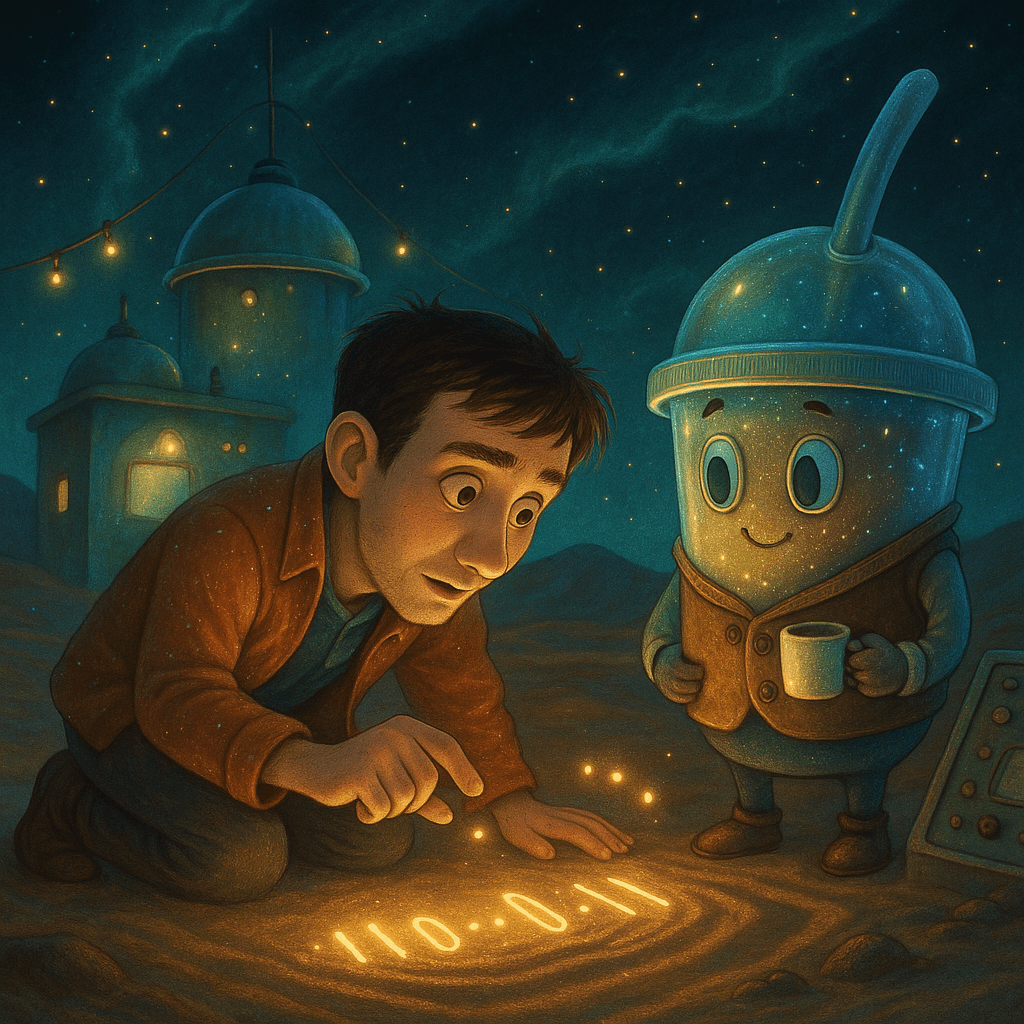
“I don’t like this,” Mickey muttered, brushing his palm over the sand. “It’s like… something tried to be here and then changed its mind.”
Near the antenna base, the sand wasn’t random. Tiny ridges formed a pattern—small bumps arranged like dots and dashes. Mickey leaned closer until his breath warmed the grains.
Mr. Coffee’s voice came softly from the station’s control panel, gentler than the radio static. “Ah, you see it too. That’s good. Now, remember: we don’t rush messages. We listen to them.”
Mickey swallowed. “But you told me you’ve been responsible for keeping the sky-radio working. What if we mess up and it’s… important?”
Mr. Coffee gave a thoughtful sigh. “I would prefer to be correct. But I also prefer to be careful. There’s a difference.”

They tested the pattern with pebbles—tap-tap… pause… tap-tap-tap—matching the dots and dashes Mickey had noticed. Each strike pressed a crisp rhythm into the sand. For a moment, nothing happened.
Then the sky-radio crackled.
Not words. Not a voice. Just a faint echo threading through the static, repeating the same rhythm—like the desert had thrown the sound back at them.

Mickey’s eyes widened. Hope fluttered in his chest, followed immediately by fear. “That’s it,” he whispered. “It’s coming from… somewhere.”
The station lights flickered, and suddenly a new frequency brightened on the display. A tiny dark object drifted in a screen view—near outer space, blinking in irregular pulses.
Mr. Coffee sounded tense now, like steam about to hiss. “That pulse timing… could it be the same rhythm?”

Mickey compared the blinking to the sand pattern, counting without meaning to. “It matches. The dots and dashes are… the same.”
The object’s path, projected by the station, angled toward the station’s line. Mickey’s stomach tightened. “It’s moving toward us!”
Mr. Coffee tried to rush, his words tumbling. “Then we—”
Mickey held up a hand. “No. Slow. If it’s navigation, we have to decode it right, not just guess.”
Mr. Coffee hovered near the control panel like a nervous helper who wanted to do everything at once. “Decoding is… my favorite kind of responsibility. But—”
He reached for a leftover gadget button labeled AIR BREW, and the station emitted a silly puff. A sand-scented thermos appeared with a little bubble sound, and the air filled with a warm, coffee-shop smell.
Mickey burst into laughter despite himself. “Mr. Coffee, why does it smell like desert snacks?”
Mr. Coffee cleared his throat, trying to sound dignified. “The station is… offering ambiance. For focus.”
Mickey wiped at his eyes, still smiling. Then his face sobered. “Okay. Let’s do this. Navigation rhythm means timing matters, not just pattern.”
They measured the desert wind with a streamer tied to a stake, watching how the cloth snapped and curled. Sand swirled in thin spirals that pointed the way the air was pushing.
“Wind affects drift,” Mickey said. “So the signal’s timing offset might be shifted by the way the probe’s pulses are arriving.”
Mr. Coffee nodded, his voice calmer now that they had a method. “Meaning: we correct the rhythm’s timing using the wind’s direction and strength.”
They adjusted the station timing offset—tiny changes, measured and tested. The object on the screen blinked again, and this time the pulses seemed to line up more cleanly, like it had heard them and was trying to match.
Then the object suddenly emitted a louder burst.
The station speakers popped, and the sound wasn’t static anymore—it was a strained, repeating beacon, almost like someone tapping from behind a wall.
Mickey leaned toward the screen. “It’s not a villain craft. It’s… a lost probe. It’s broadcasting because it’s running out of power.”
Mr. Coffee’s voice softened. “Then we must help it find where it is safely.”
But the burst was incomplete. Their decoding gave partial information—enough to understand the beacon’s rhythm, not enough to calculate a perfect approach vector.
Mickey stared at the projected path and felt that familiar tug of worry. “We can send what we have,” he said slowly, “but what if it’s not enough?”
Mr. Coffee’s circuitry whirred. “Or we could compute using all our desert measurements—wind direction, timing correction, and the station’s estimated drift. That will take a moment.”
Mickey looked at the antenna, at the streamer, at the sand ridges that had started it all. He remembered how the echo had matched their tapping. “Let’s help it first,” he decided, voice steady. “Even if we’re scared.”
He reached for the final calculation controls with Mr. Coffee, and together they used the full set of desert data to compute the safest approach vector—balancing timing, wind push, and the station’s own orientation.
When they transmitted, the sky-radio lights glowed brighter than before. A clear alert—rhythm plus direction—went out in the language the probe could understand.
On the screen, the probe’s beacon steadied. Its blinking changed from irregular pulses to a consistent pattern, like a heartbeat finding its rhythm again.
Moments later, the radio crackled with a response—human voices, thin and surprised through the static. “Desert station—if you can hear us… thank you. Your wind clue matched our internal drift model. We’re rerouting now.”
Mickey felt something warm settle in his chest, replacing earlier panic with quiet pride. “So the desert wasn’t just… sand,” he said.
Mr. Coffee chuckled softly. “The desert is full of messages. We simply needed patience enough to hear them.”
The station’s automated guidance rerouted, and the projected collision path disappeared. The probe’s trajectory moved safely away, guided by the alert they’d sent.
As the wind continued to write invisible lines across the dunes, Mickey sat back on his heels. He still worried sometimes—about being wrong, about missing important things—but now he knew mysteries didn’t demand instant answers. They invited listening.
Mr. Coffee’s voice was gentle, like a cup warming in someone’s hands. “You did well, Mickey. You slowed down when it mattered.”
Mickey smiled, watching the sky-radio settle into a calm, steady glow. “And we helped it first,” he said.
Outside, the desert kept breathing—quiet, vast, and full of rhythms waiting for two friends to notice them.