Chapter 1: Cool Drink Promise
Morning at the Beach arrived with a salty sigh and a bright, watchful sun. The sand was already warm enough to sting the soles of bare feet, and the air smelled like sunscreen and seaweed drying on rocks. Every step left a dotted trail of footprints—tiny commas in the story of the day.

Near a towel-draped cooler, Mr. Coffee hovered with the careful seriousness of someone trying not to spill their own feelings. He was friendly, a little anxious, and proud of one simple job: keep his ice cubes intact so he could help everyone cool down after playing.
“Okay,” he seemed to say without words, his little lid tilted like he was listening for trouble. “No melting. Not too warm. Too warm is… bad.”

The ice cubes inside him were doing their best, but the Beach sun had a talent for turning minutes into puddles. A faint squeak—like a tiny rubber band stretching—came from the cooler as one cube softened. Then another. The sound wasn’t loud, but it was steady, like a countdown.
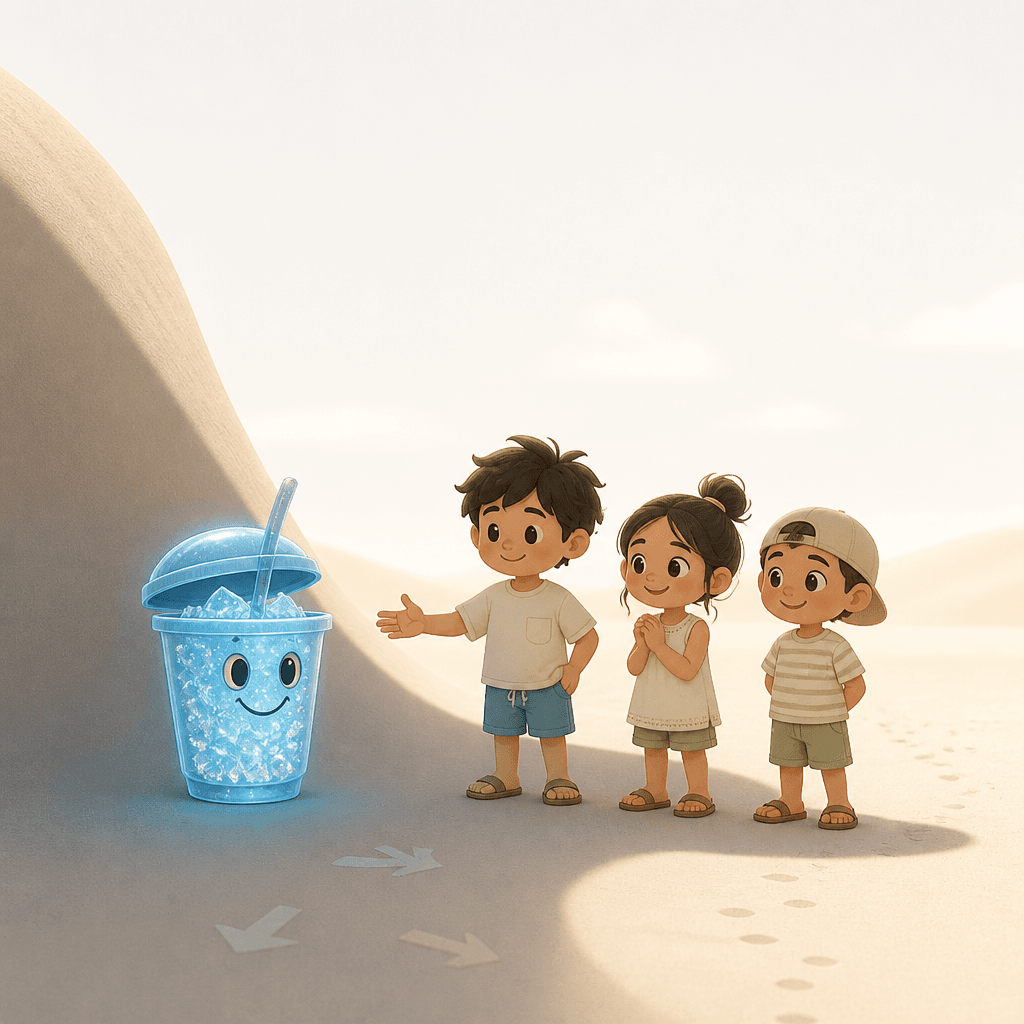
Middle-school kids—quick with jokes and even quicker to notice what didn’t add up—gathered around. They were the kind of group that could turn a mystery into a game, but today their laughter came out softer.
“Mr. Coffee,” one of them said, trying to sound cheerful, “why are you melting so fast?”
Mr. Coffee’s “expression” tightened. He didn’t like being the problem.
They leaned in, ready to help, and that’s when they saw it: foam dots arranged in a loose pattern, like tiny arrows pointing across the sand toward a dune. Some dots were colder-looking, others already turning cloudy.
A warm shell lay half-buried nearby, bright against the darker sand. It was so warm it looked almost guilty.
And beneath a patch of seaweed, a faint hissing sound ticked like a secret.
The kids exchanged a look—half “this is weird,” half “we can figure it out.”
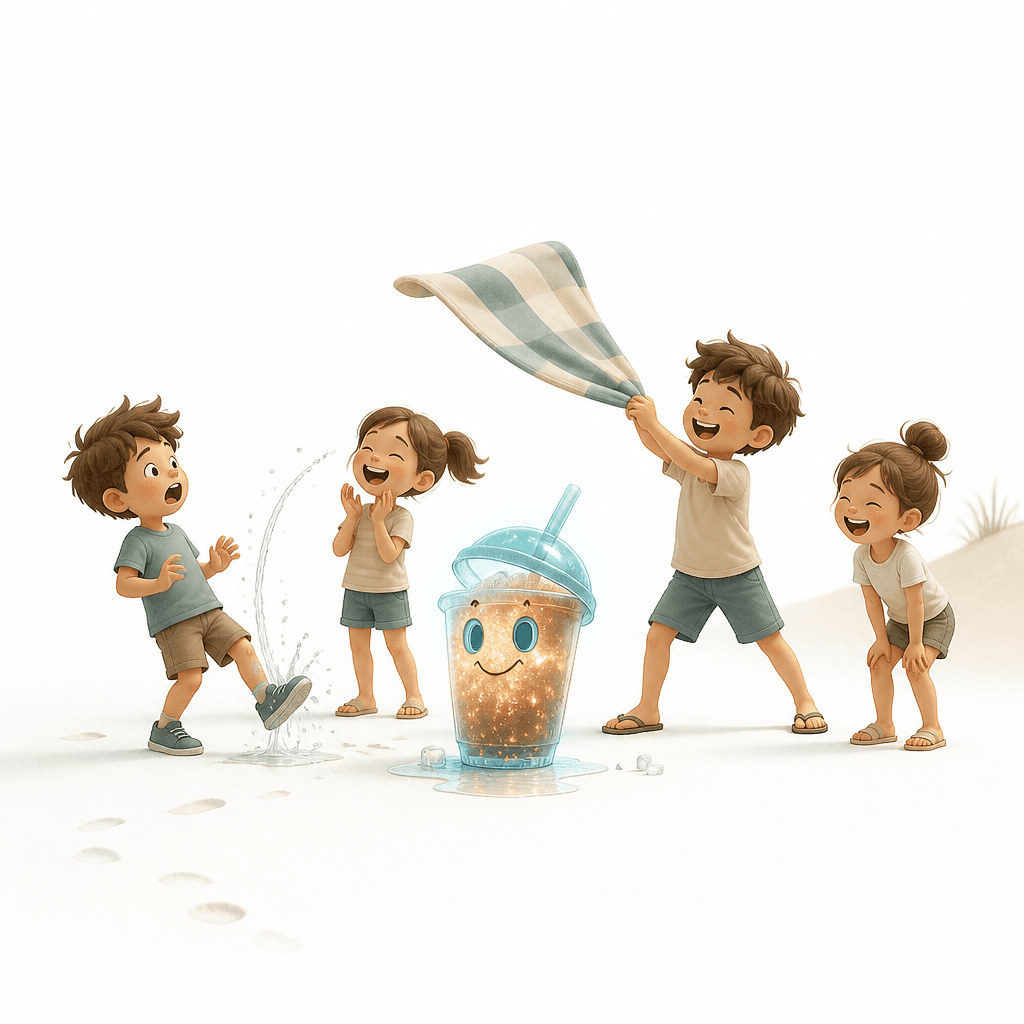
Then came the comedic moment. One friend grabbed a beach towel and declared, “We’ll slow time!”
They fanned the cooler like it was a campfire that needed attention.
The universe, unimpressed, answered with a wave. The towel slipped, and a spray of melted-water shot straight onto their own shoes.
“Ah—my feet!” they yelped, then burst into laughter so loud even Mr. Coffee seemed to relax. “Sorry! Sorry, Mr. Coffee!”
Mr. Coffee bobbed in relief, as if the apology mattered more than the splash.
But the mystery didn’t laugh. It waited.
They started comparing clues like detectives with salty hands. The foam arrows pointed toward the dune, so they checked temperature differences by touch—quick, careful touches, no heroics. The sand near the foam felt cooler than the sand near the shell.
Next came scent. The kids sniffed near the seaweed patch, where the hissing seemed to hide. It smelled faintly like warm plastic and sun-baked metal, not like the ocean.
They tested ideas safely. First, they placed cool sand around the cooler to create a buffer, then shifted it to stay in shade. They checked the sun’s angle by watching how quickly shadows moved across the sand.
Still, Mr. Coffee’s ice cubes melted faster whenever they were too close to the warm area.
That’s when the shell gave them the answer they didn’t realize they needed.
They pressed gently around it, and the sand beneath felt warmer than the sand beside it—like something had been heating from below. The shell wasn’t just warm; it was part of a heat pocket.
“Maybe it’s magic,” someone whispered, then immediately shook their head. “No—nothing’s magic. It’s probably… a thing.”
They dug carefully, just enough to see what was under the surface. A stranded, sun-baked device component—something from a lost beach toy—sat wedged in the sand. Heat had trapped in it, then transferred upward through the shell and the surrounding layer.
No spell. Just physics and bad luck.
In the climax of their problem-solving, they worked like a team with a shared mission. They dug a small trench to remove the warmed sand from beneath the shell’s heat pocket. They cooled the area with seawater—careful not to flood the cooler, just enough to bring the sand back down.
Then they repositioned Mr. Coffee into deeper shade cast by a dune’s curve. They nudged the cooler a few inches at a time, checking that the shade stayed steady as the sun shifted.
Mr. Coffee’s lid lifted a fraction, and his whole body seemed to sigh.
The squeaky melting slowed. The cubes held their shape. The ice no longer fought the Beach; the Beach became background noise.
“Thank you,” the kids said, and this time it wasn’t only for fixing the problem. It was for understanding why he’d been worried.
Mr. Coffee looked… grateful. Not triumphant, not perfect—just relieved.
When the first cool drinks were finally ready, everyone felt it: the warmth of accomplishment, the cool of relief, and the laughter that comes after you’ve solved something together.
As the morning stretched into afternoon, the kids made a promise with their eyes open. They’d keep looking for clues—foam arrows, strange warmth, hissing secrets—because if anyone felt like their “cool” was disappearing, they’d know how to help them find it again.